
Masking pattern
Description
A Masking pattern describes how Mask fields replaces the values of a field. The transform only assigns a pattern to each field. The same pattern can be used in more than one pipeline.
Patterns are stored as JSON under metadata/masking-pattern/.
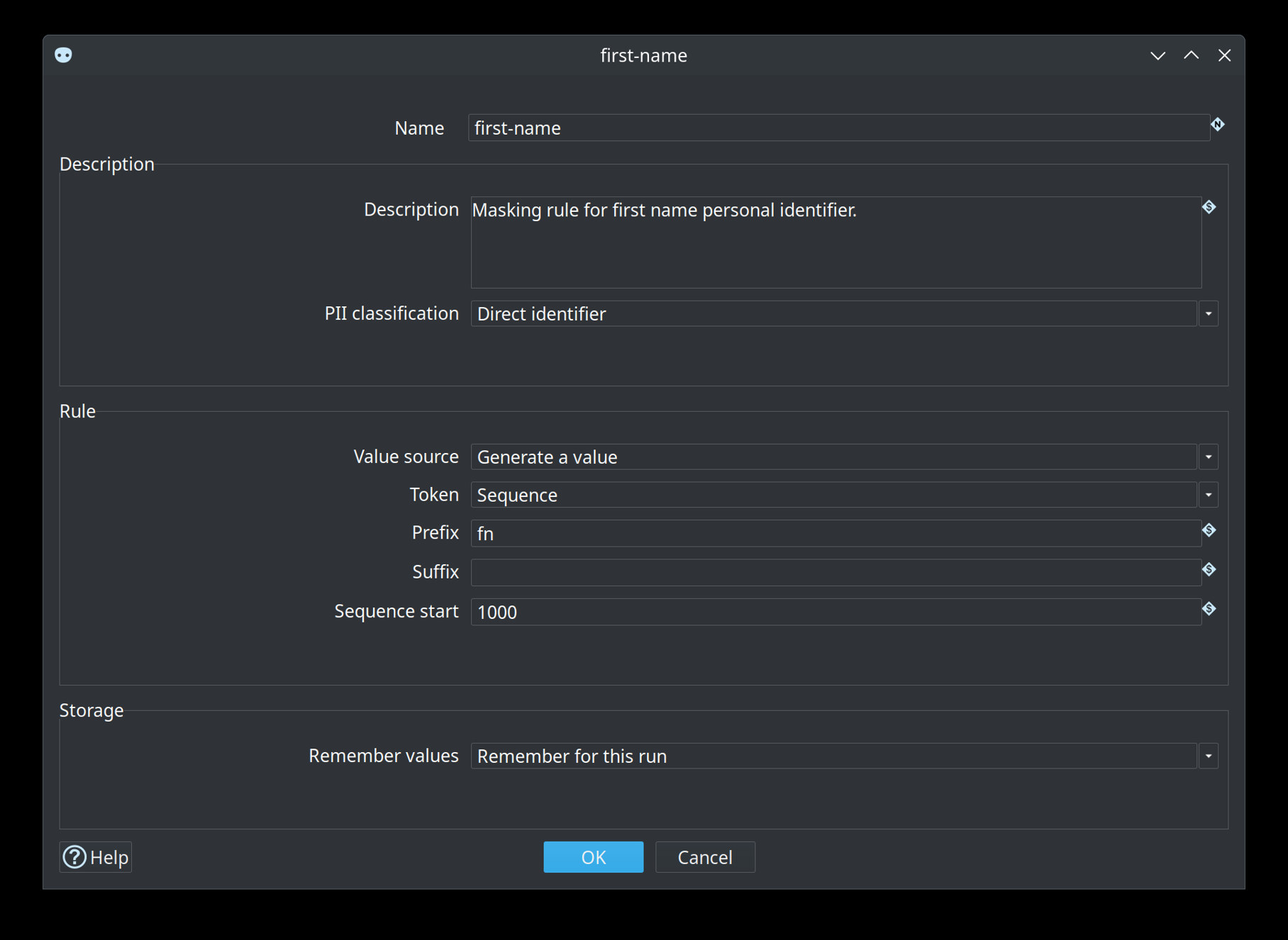
Properties
| Property | Description |
|---|---|
Name |
Name shown in the transform. |
Description |
What this pattern is for. |
PII classification |
A label for people working with the metadata. Suggested values are Direct identifier, Quasi-identifier, Sensitive and Special category. You can type another term. The transform does not read this value. |
Value source |
SYNTHETIC builds a token. SET_NULL clears the field. SET_EMPTY writes a blank string. |
Token |
SEQUENCE or UUID. Used by SYNTHETIC. |
Prefix |
Text written before the token on a string field, for example |
Suffix |
Text written after the token on a string field. |
Sequence start |
First integer. The default is 1. |
Remember values |
NONE assigns a new value every row. MEMORY keeps the mapping for one run. DATABASE keeps it in a table across runs. |
Ignore surrounding spaces |
Values that only differ in leading or trailing spaces get the same replacement. A value of only spaces is left unchanged. Used by MEMORY and DATABASE. |
Ignore case |
Values that only differ in upper and lower case get the same replacement. Used by MEMORY and DATABASE. |
Connection |
Database connection for DATABASE. |
Schema |
Schema of the mapping table. Empty uses the connection default. |
Table |
Mapping table. A second table with the suffix |
Hash secret |
The mapping table stores an HMAC-SHA256 of each value, made with this secret, instead of the value itself. Use a variable such as |