
Hop setup
hop setup configures the launcher environment variables that Hop reads before Java starts.
This is different from hop conf, which edits hop-config.json (projects, system variables, GUI options).
Without these variables Hop uses the installation config/ and audit/ folders. After an upgrade those folders are gone. Setup writes the variables to your user environment, a shell startup file, and/or a hop-env script so configuration lives outside the install.
Recommended folders
| Variable | Linux / macOS | Windows |
|---|---|---|
${HOP_CONFIG_FOLDER} |
|
|
${HOP_AUDIT_FOLDER} |
|
|
You can also set ${HOP_JAVA_HOME}, ${HOP_OPTIONS} and ${HOP_SHARED_JDBC_FOLDERS}.
Hop Gui
Open the configurator from:
-
Tools → Configure Hop environment…
-
The Welcome dialog topic Environment setup
-
The first-start question, when
${HOP_CONFIG_FOLDER}is not set
On first start Hop asks whether to keep configuration outside the installation folder:
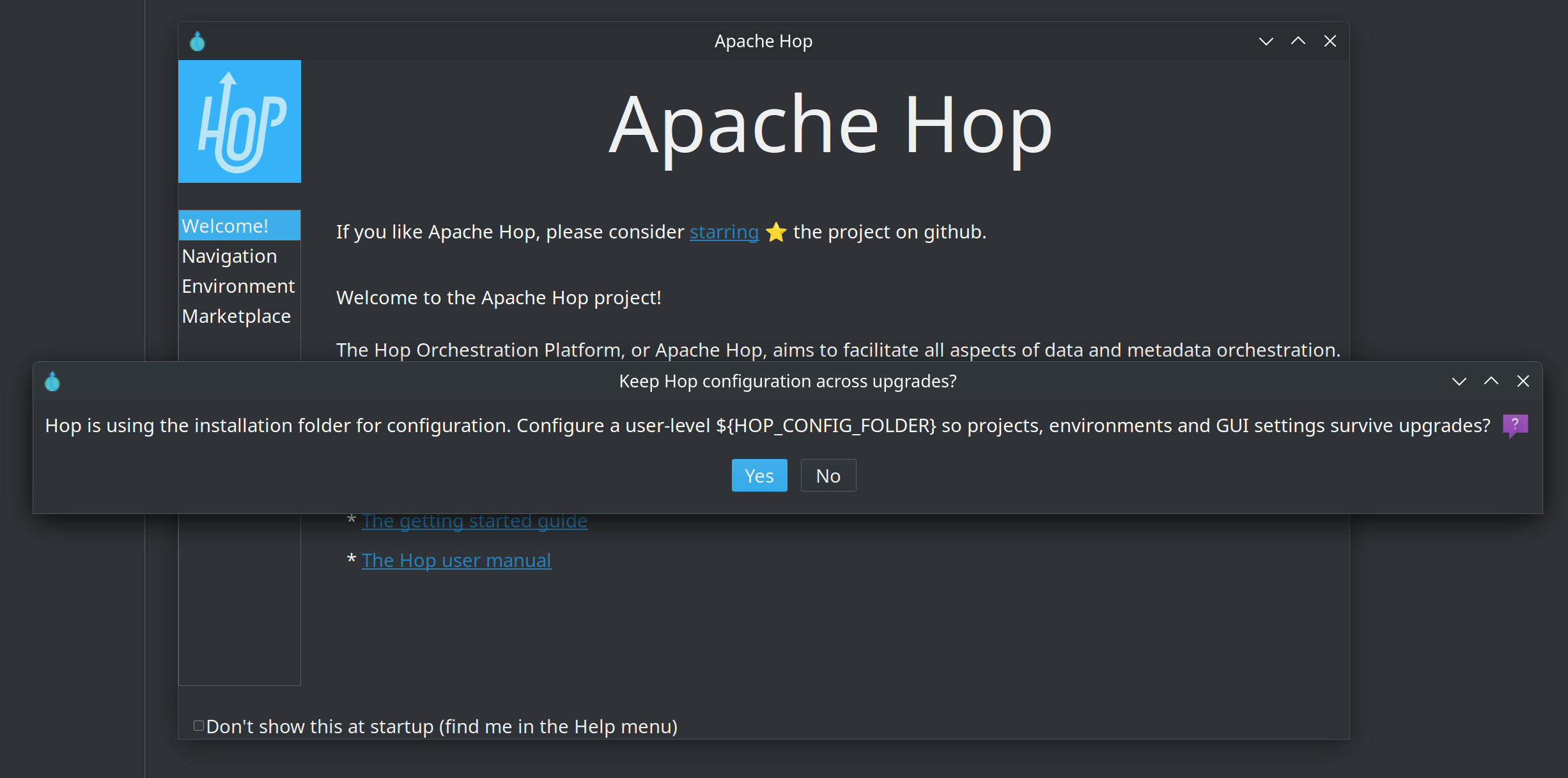
Yes opens the configurator with the recommended folders filled in. No skips the prompt (you can still open it from the Tools menu).
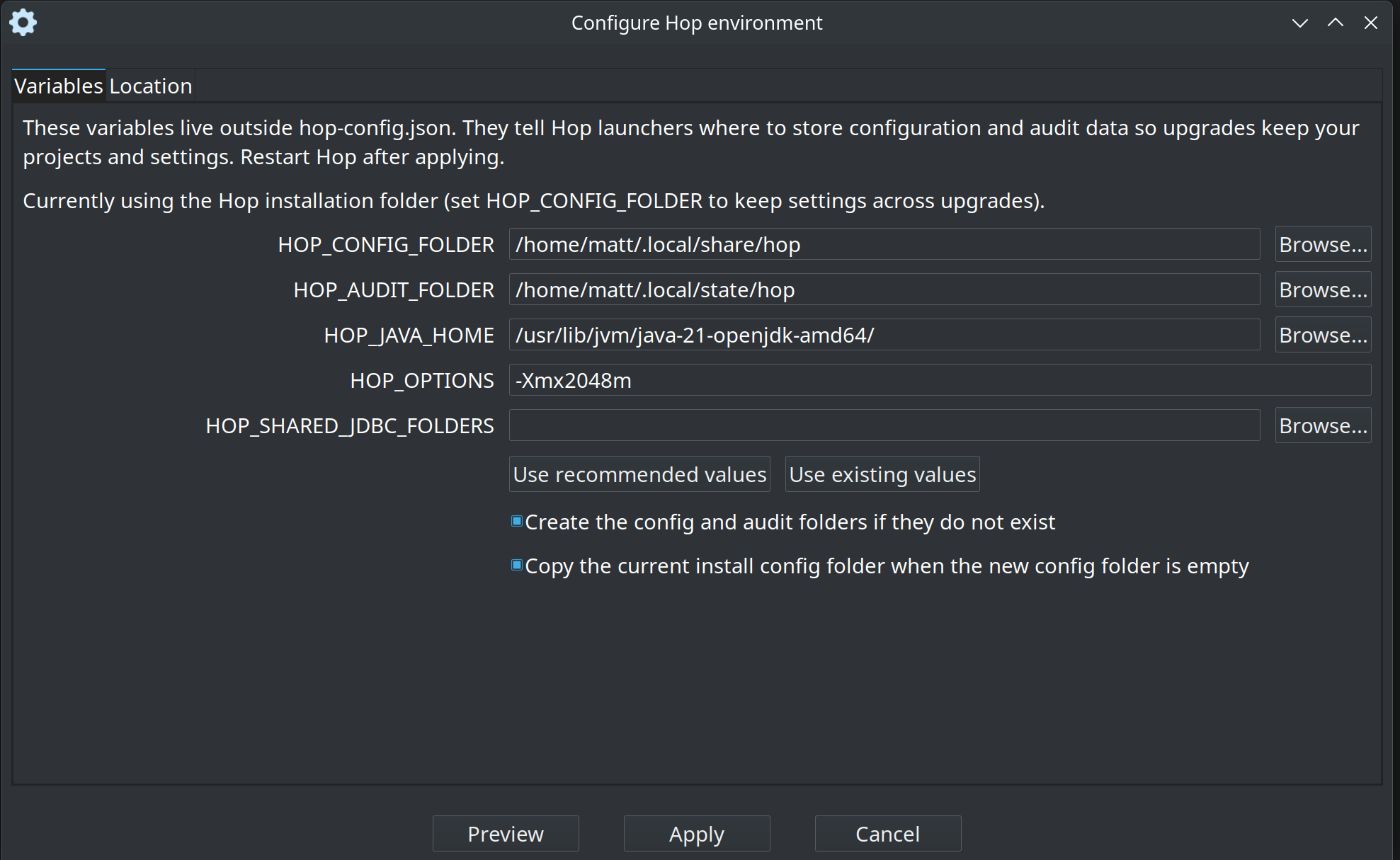
Variables tab
Set ${HOP_CONFIG_FOLDER}, ${HOP_AUDIT_FOLDER}, ${HOP_JAVA_HOME}, ${HOP_OPTIONS} and ${HOP_SHARED_JDBC_FOLDERS}.
-
Use recommended values — platform folders (
~/.local/share/hopand~/.local/state/hopon Linux/macOS,%USERPROFILE%\.hop\configandauditon Windows). -
Use existing values — the current environment, or
./configand./auditwhen those variables are unset. -
Create the config and audit folders and Copy the current install config folder when the new config folder is empty.
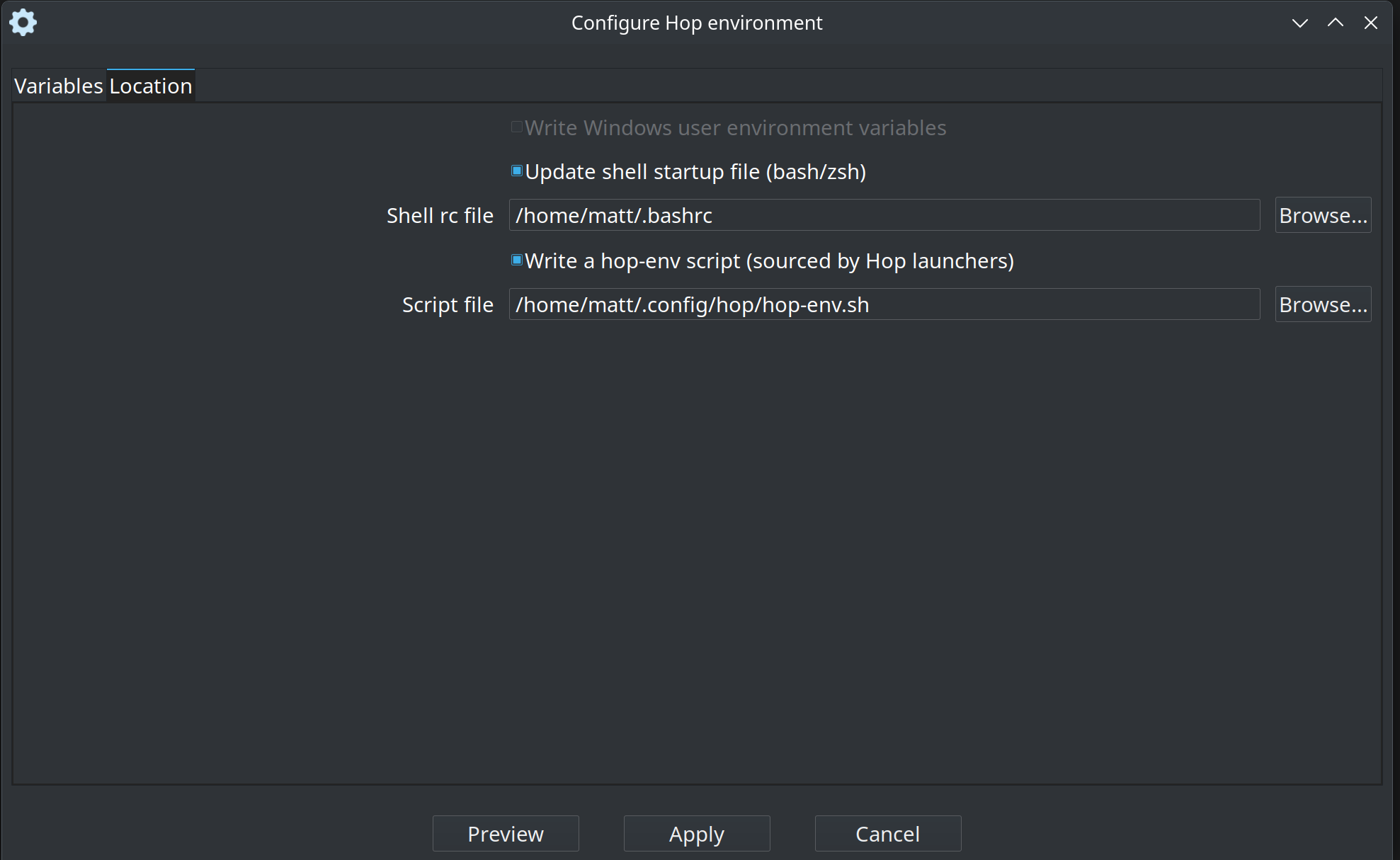
Location tab
Choose where to write the variables:
-
Windows user environment variables
-
Shell startup file (
~/.bashrcor~/.zshrc) -
A
hop-envscript sourced by Hop launchers (~/.config/hop/hop-env.shor%USERPROFILE%\.hop\hop-env.cmd)
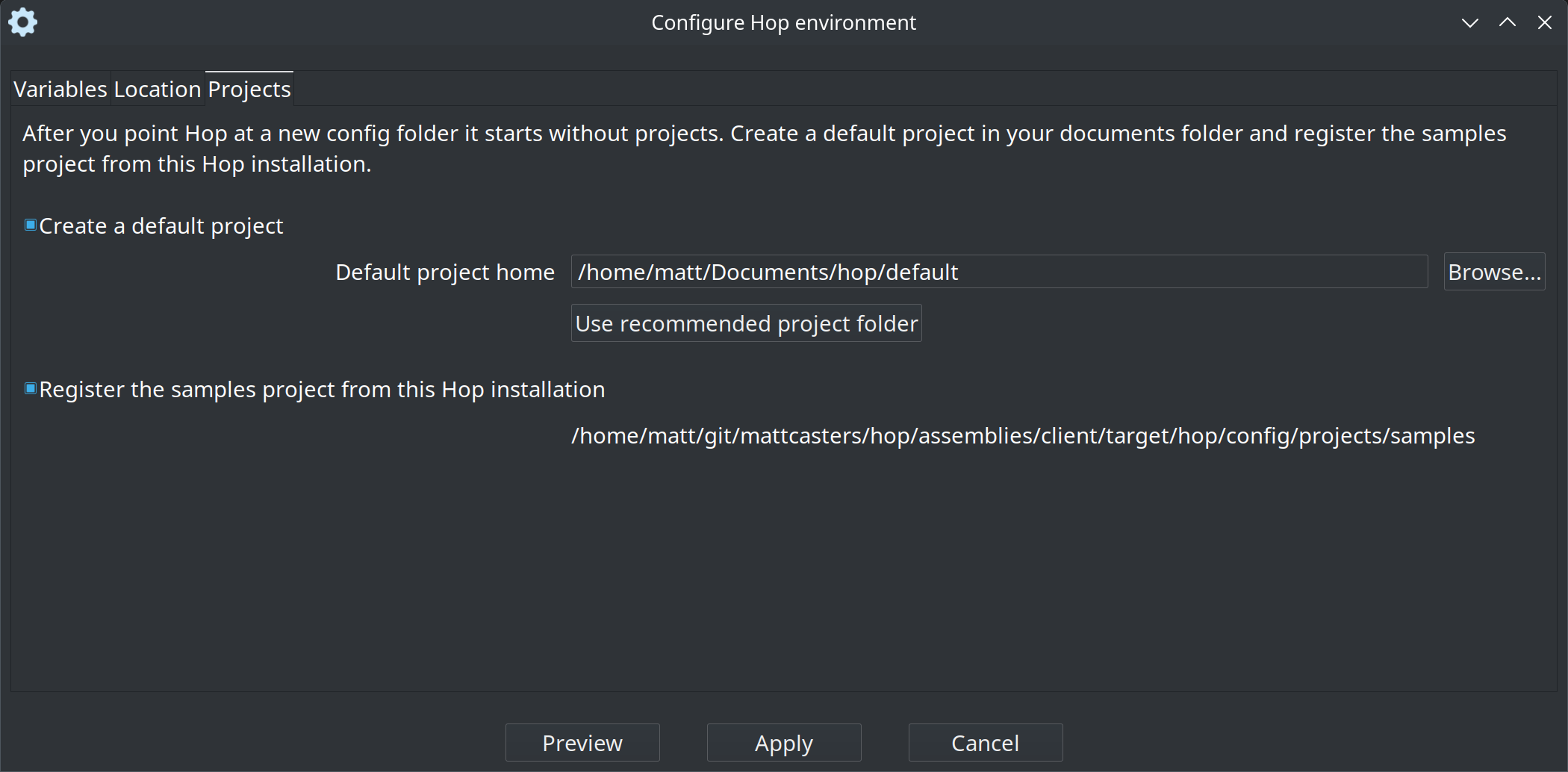
Projects tab
A new ${HOP_CONFIG_FOLDER} starts without projects. On the Projects tab you can:
-
Create a default project in a user documents folder:
-
Linux:
~/Documents/hop/default -
macOS:
~/hop/default -
Windows:
%USERPROFILE%\Documents\Hop\default
-
-
Register the samples project from this Hop installation (
<install>/config/projects/samples) so the examples stay available after the config folder moves.
Both options are selected by default. Apply writes them into the new hop-config.json (and creates project-config.json plus the install default-project template when the default home is empty).
Preview and apply
Preview shows the planned files without writing them:
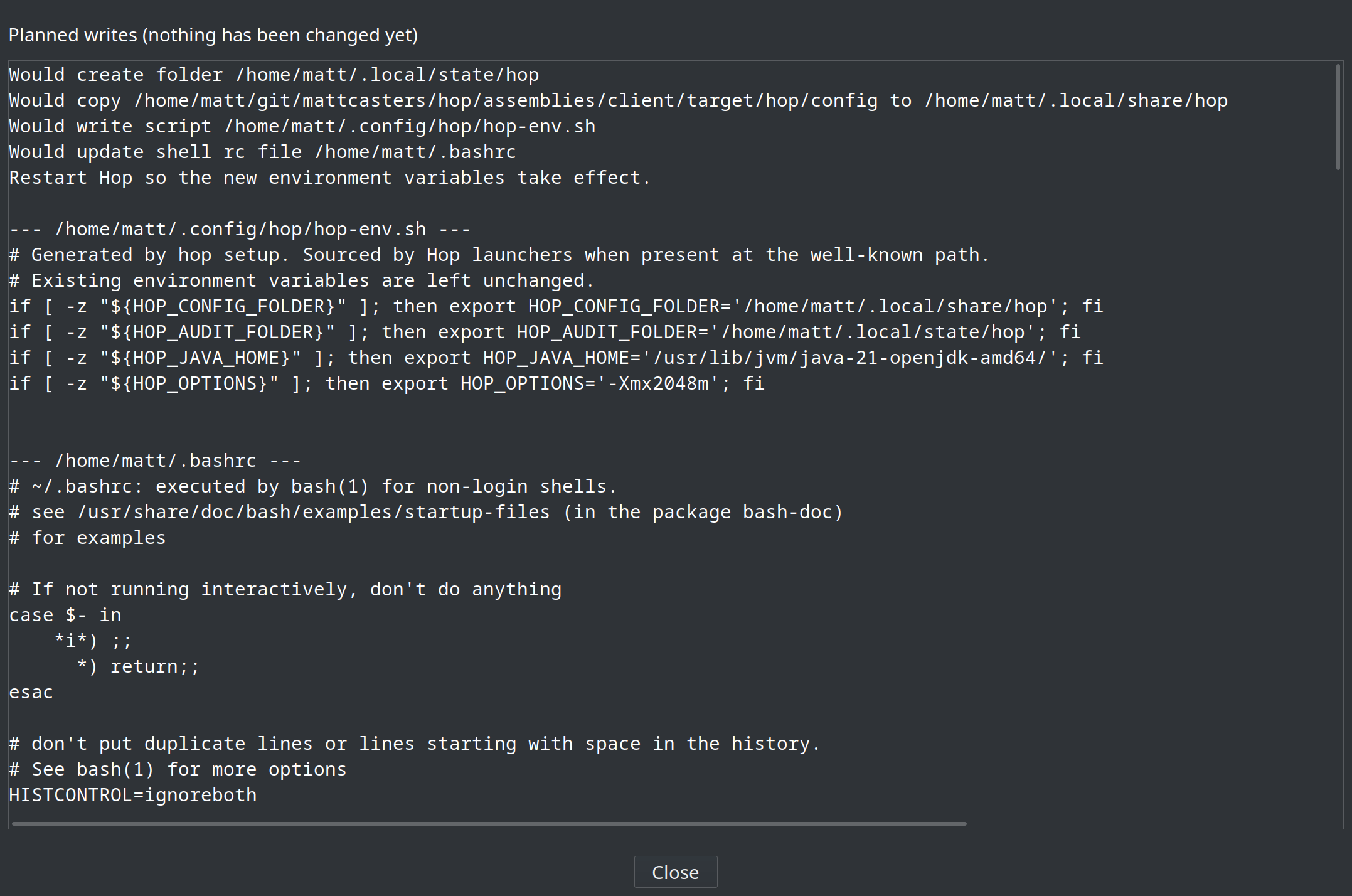
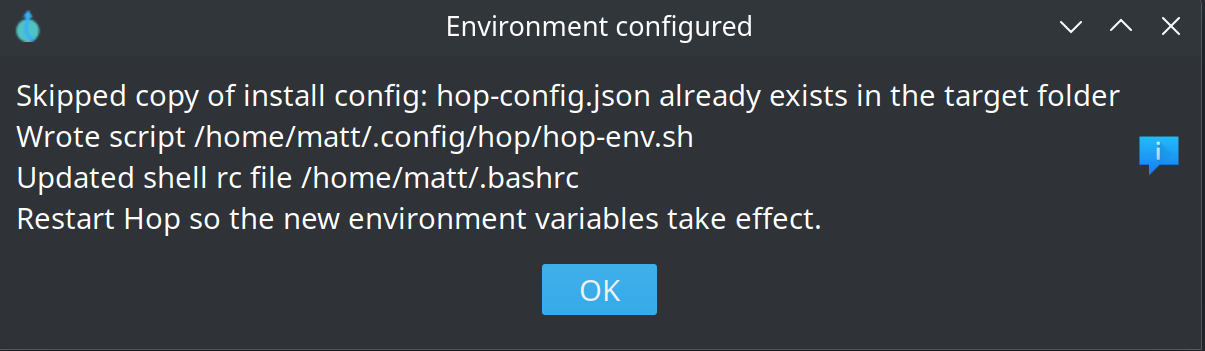
Apply writes the selected targets. Restart Hop so the new folders take effect:
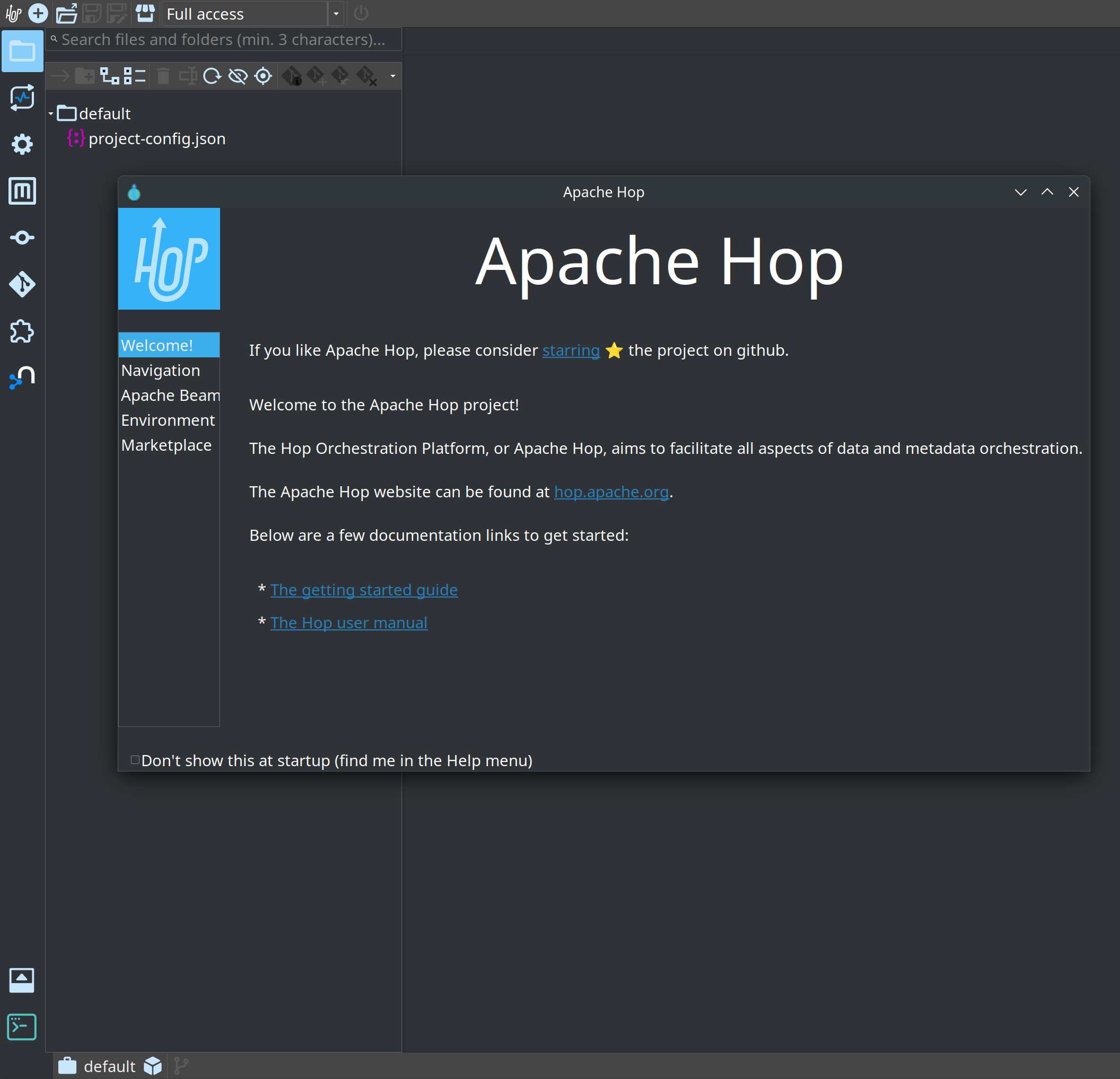
After restart, Hop Gui opens the new default project:
Hop Web does not write the server operating system environment. Use Preview and apply the generated script on the machine that starts Hop.
Command line
From the Hop install directory:
./hop setup
./hop setup show
./hop setup apply --defaults
./hop setup apply --defaults --dry-run
./hop setup apply --config-folder /data/hop/config --audit-folder /data/hop/audit --script
On Windows use hop.bat setup apply --defaults.
apply options
| Option | Description |
|---|---|
|
Value for |
|
Value for |
|
Value for |
|
Value for |
|
Value for |
|
Fill unspecified config/audit folders with the recommended paths and register a default project plus samples |
|
Write Windows user environment variables |
|
Update |
|
Override the rc file path |
|
Write a hop-env script |
|
Override the script path (default: |
|
Create a default project (implied by |
|
Home folder of the default project |
|
Register |
|
Copy |
|
Create the config and audit folders (default: create) |
|
Print the planned files without writing |
If you do not pick a write target, Hop uses:
-
Windows: user environment + hop-env script
-
Linux / macOS: shell rc file + hop-env script
Hop launchers source the well-known hop-env script when it exists, so desktop shortcuts pick up the folders after a restart. An environment variable that is already set is left unchanged.
To skip the first-start prompt set ${HOP_NO_SETUP_DIALOG}=Y.